Mastering Your Camera: Understanding Key Settings for Captivating Shots
- Hannah Middaugh
- May 21
- 2 min read

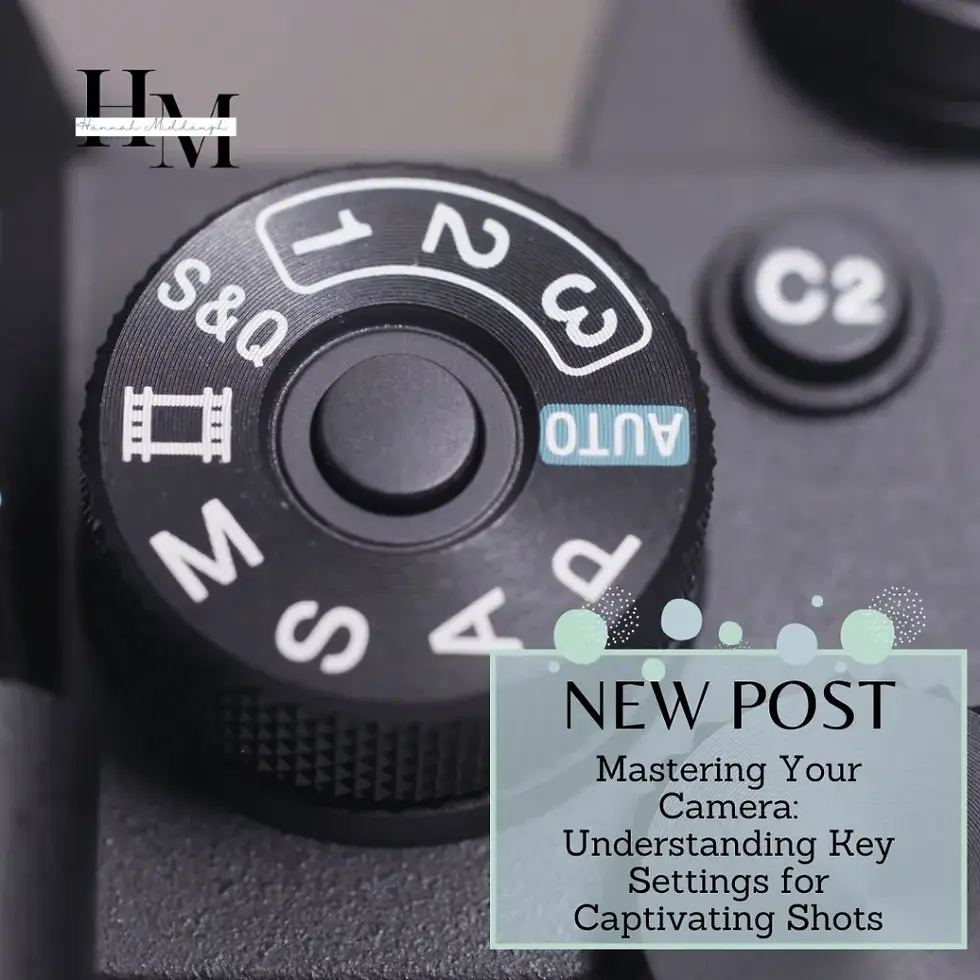
Capturing the perfect shot involves more than just pointing and clicking. Understanding your camera’s settings empowers photographers to unleash their creativity and take stunning photographs. Here are some fundamental settings every photographer should know:
1. Shutter Speed:
Shutter speed controls the duration of time the camera’s sensor is exposed to light. A faster shutter speed freezes motion, ideal for sports or fast-moving subjects, while a slower speed creates motion blur, perfect for capturing the flow of water or creating artistic effects.
2. Aperture (F-Stop):
Aperture controls the size of the lens opening, determining the amount of light that enters the camera. A lower f-stop (wider aperture) lets in more light and creates a shallower depth of field, perfect for portraits. Higher f-stops (narrower aperture) yield sharper images with more in focus, ideal for landscapes.
3. ISO Sensitivity:
ISO measures the camera sensor’s sensitivity to light. Higher ISO settings allow for shooting in low-light conditions but may introduce noise or graininess to the image. Lower ISO settings produce cleaner images but require more light for proper exposure.
4. White Balance:
White balance ensures accurate color representation in different lighting conditions. Adjusting white balance presets or manually setting it can prevent images from appearing too warm (yellowish) or too cool (bluish).
5. Focus Modes:
Understanding and utilizing different focus modes (such as single, continuous, or manual focus) allows photographers to capture sharp images based on their subject’s movement and depth of field requirements.
6. Exposure Compensation:
Exposure compensation helps adjust the camera’s automatic exposure settings. It allows for fine-tuning exposure levels in situations where the camera’s metering might misinterpret lighting conditions.
7. Metering Modes:
Camera metering modes determine how the camera measures light. Evaluative/matrix metering, spot metering, and center-weighted metering provide various ways to measure light, allowing photographers to choose the most suitable mode for their scene.
8. File Format and Image Quality:
Choosing between RAW and JPEG formats impacts post-processing flexibility. RAW files retain more data and allow for extensive editing, while JPEG files are smaller and more easily shareable but have limited editing capabilities.
9. Drive Modes and Burst Shooting:
Understanding drive modes, such as single-shot, continuous, or self-timer, allows photographers to capture action sequences or choose the best timing for their shots.
10. Image Stabilization:
Some cameras offer in-body or lens-based image stabilization, reducing blur caused by shaky hands or low-light conditions. Understanding and using this feature appropriately can significantly improve image sharpness.
Mastering these key camera settings empowers photographers to exercise greater control over their images, experiment with different creative techniques, and adapt to diverse shooting scenarios. Continual practice and exploration of these settings are crucial to refining one’s photographic skills and capturing stunning moments with precision and artistry.


Comments